I'm upset at how fast and easily I've reintegrated into North America. It might sound peculiar, but I feel that in some way it belittles my time spent in Ethiopia. I hate how my memories are fixed, in complete opposition to the dynamism that I experienced while living there. It's almost as if, except for the photos and friends made, that I've never even set foot in Addis. I feel like it's too soon that my Habesha memories have been transferred from present tense into past tense.
To top it all off, I'm experiencing devastating writers block...I planned to come back and write write write about Ethiopia and it's wonders and our missconceptions from this side of the Atlantic. No such luck. It would seem that the words only come in situ.
The only solution is to go back!
Showing posts with label travel. Show all posts
Showing posts with label travel. Show all posts
Thursday, August 30, 2007


Monday, July 09, 2007
Tips for Reintegration
They say that returning home after spending time in a different country can be harder than adjusting to life away in the first place. My culture shock comes in waves, alternating between experiencing pleasant surprises of ‘home’ and marveling at its deficiencies. Most significantly, I find myself asking, ‘is this it?’ as I participate in conversations and activities that don’t seem quite as vital as those I experienced in Ethiopia. One week in, here’s a list of tips for others in the same situation:
1. Don’t go home.
After a day in Toronto, I continued on to Boston where I’ll spend the last two months of the summer. Being in a new place provides excellent distraction from not being in Addis any longer, a distraction that wouldn’t be possible in a familiar city.
2. Join Facebook.
Adding the friends that you made overseas helps ease the transition away from roommates, coworkers and buddies, and into new interactions. I feel less lonely for my friends in Addis because I can keep track of their lives and converse with them on a daily basis. It makes them seem not quite so far away.
3. Stay involved.
If you were working for a company or ngo overseas, organize some tasks for yourself to do upon returning home. CPAR has asked me to do some writing for its newsletters, and I have some follow up to do with CAPAIDS. These tasks also provide a link with the life I lived in Ethiopia, and help mitigate the feelings of uselessness that comes from leaving a job I loved.
4. Link with other recent returnees.
On my first night back, I went to a bbq with some friends who I’d met in Addis. I’m afraid I might have overused their sympathetic ears, but being able to talk to someone who related was great. One of my friends hadn’t left the house since arriving back three weeks ago!
5. Channel your feelings of withdrawal.
Work on something related to your experience helps to minimize the feeling that the whole thing was a dream. Some suggestions: write an article about the country you visited for an online publication, organize a small fundraiser for an organization you became familiar with overseas, do a presentation for the organization you were overseas with…
1. Don’t go home.
After a day in Toronto, I continued on to Boston where I’ll spend the last two months of the summer. Being in a new place provides excellent distraction from not being in Addis any longer, a distraction that wouldn’t be possible in a familiar city.
2. Join Facebook.
Adding the friends that you made overseas helps ease the transition away from roommates, coworkers and buddies, and into new interactions. I feel less lonely for my friends in Addis because I can keep track of their lives and converse with them on a daily basis. It makes them seem not quite so far away.
3. Stay involved.
If you were working for a company or ngo overseas, organize some tasks for yourself to do upon returning home. CPAR has asked me to do some writing for its newsletters, and I have some follow up to do with CAPAIDS. These tasks also provide a link with the life I lived in Ethiopia, and help mitigate the feelings of uselessness that comes from leaving a job I loved.
4. Link with other recent returnees.
On my first night back, I went to a bbq with some friends who I’d met in Addis. I’m afraid I might have overused their sympathetic ears, but being able to talk to someone who related was great. One of my friends hadn’t left the house since arriving back three weeks ago!
5. Channel your feelings of withdrawal.
Work on something related to your experience helps to minimize the feeling that the whole thing was a dream. Some suggestions: write an article about the country you visited for an online publication, organize a small fundraiser for an organization you became familiar with overseas, do a presentation for the organization you were overseas with…
Thursday, January 11, 2007
African Homecoming
It is with many apologies for a prolonged blog absence that I come back online after my East African vacation. Over the past three weeks, I've travelled through Uganda, Kenya and Tanzania, making it as far as Zanzibar off the East coast of the continent. Relaxed and with visa, I am back at my desk in the CPAR office in Addis Ababa.
While my trip was a vacation, it got me thinking a lot about Ethiopia's unique development situation in the continent. Never having been colonized, the differences between Addis and somewhere like cosmopolitain Nairobi are immediately apparent. Everything from the prices, the infrastructure, and the goods available had me feeling like I was in a North American suburb. Looking farther, past the material goods and shiny billboards, even the representations of poverty and the attitudes towards foreigners were different in all three countries as compared with Ethiopia. These differences made me realize just how self-directed the action within this country is, with society and government making things up as they go along, rather than taking an example from other nations. Now that I've realized this, I'll try to think about it more, looking for the ways in which Ethiopians are innovating their own futures, both on an individual and societal level.
As the plane touched down at the airport in Addis, I found myself bouncing in my seat, happy to be home.
While my trip was a vacation, it got me thinking a lot about Ethiopia's unique development situation in the continent. Never having been colonized, the differences between Addis and somewhere like cosmopolitain Nairobi are immediately apparent. Everything from the prices, the infrastructure, and the goods available had me feeling like I was in a North American suburb. Looking farther, past the material goods and shiny billboards, even the representations of poverty and the attitudes towards foreigners were different in all three countries as compared with Ethiopia. These differences made me realize just how self-directed the action within this country is, with society and government making things up as they go along, rather than taking an example from other nations. Now that I've realized this, I'll try to think about it more, looking for the ways in which Ethiopians are innovating their own futures, both on an individual and societal level.
As the plane touched down at the airport in Addis, I found myself bouncing in my seat, happy to be home.
Wednesday, December 20, 2006
 Downtown Kampala, 5 days before Christmas
 Urban Wildlife in Downtown Kampala
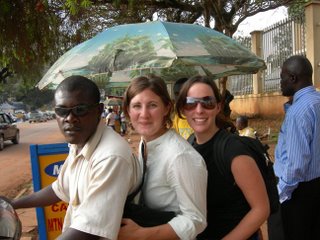 Canadian Interns on a BodaBoda motorcycle taxi
Tuesday, December 19, 2006
Travel Log: First Leg, Addis/Nairobi/Kampala
Here I am on my "required" vacation, as a result of visa problems in Ethiopia. What a hard life!
On Sunday evening I flew from Ethiopia to Kenya, and spent the night with another intern in Nairobi. The next morning I found myself at a bus station, confused and lost with no idea which bus I was supposed to be on. I looked around, trying to find an official looking person, a signboard, or even a line that would indicate some order in the chaos. Finally, I found a man taking tickets! He told me that my bus wasn't there yet, but it would be along soon. I periodically shoved my ticket under his nose until, a few buses later, he took it and ushered me to my seat. I was destined to arrive in Kampala, Uganda fifteen hours later.
I had had some problems changing my money to Kenyan shillings because my American bills were too dishevelled for the tastes of the black market currency vendors. So, there I was on a 15 hour bus ride with no money, no water, no food, and tremendous hopes that I would manage to get a Ugandan visa. I felt a bit like Jack Kerouac's On the Road, booting it across the United States and back with very limited finances, but gaining tremendous beat insight. Finally, at 11pm, I arrived in Kampala with a very empty stomach, and a Ugandan visa in my passport.
Here I am now at the CPAR Uganda office. It's nice to see another branch of CPAR, visiting the ever enthusiastic staff and different programs. I look forward to seeing as much of this country as I can in such a short 6 days. Yet despite this mini-adventure within the larger internship adventure, I find myself missing Ethiopia already!
Christmas Reading Recommendation: My Heart is Africa by Scott Griffin, a Canadian who flew from Toronto to Nairobi where he worked with the Flying Doctors Service for two years.
On Sunday evening I flew from Ethiopia to Kenya, and spent the night with another intern in Nairobi. The next morning I found myself at a bus station, confused and lost with no idea which bus I was supposed to be on. I looked around, trying to find an official looking person, a signboard, or even a line that would indicate some order in the chaos. Finally, I found a man taking tickets! He told me that my bus wasn't there yet, but it would be along soon. I periodically shoved my ticket under his nose until, a few buses later, he took it and ushered me to my seat. I was destined to arrive in Kampala, Uganda fifteen hours later.
I had had some problems changing my money to Kenyan shillings because my American bills were too dishevelled for the tastes of the black market currency vendors. So, there I was on a 15 hour bus ride with no money, no water, no food, and tremendous hopes that I would manage to get a Ugandan visa. I felt a bit like Jack Kerouac's On the Road, booting it across the United States and back with very limited finances, but gaining tremendous beat insight. Finally, at 11pm, I arrived in Kampala with a very empty stomach, and a Ugandan visa in my passport.
Here I am now at the CPAR Uganda office. It's nice to see another branch of CPAR, visiting the ever enthusiastic staff and different programs. I look forward to seeing as much of this country as I can in such a short 6 days. Yet despite this mini-adventure within the larger internship adventure, I find myself missing Ethiopia already!
Christmas Reading Recommendation: My Heart is Africa by Scott Griffin, a Canadian who flew from Toronto to Nairobi where he worked with the Flying Doctors Service for two years.
Wednesday, December 13, 2006
Visas and Christmas
Just a quick update to those interested. Because of some problems with my visa, I've been asked (not so kindly, complete with jail and court threats) by the Ethiopian government to leave the country. My plan is to head to the CPAR office in Uganda where I will apply for another visa, and try to see as much of the projects there as possible. From there I'll go on my Christmas and New Year vacation to Kenya. Hopefully I'll be able to post about my adventures from these other African countries, but if not, holiday greetings and I'll be back in Addis on January 3rd. Just in time for Ethiopian Christmas on January 6th!
Kate
Kate
Monday, October 30, 2006
Dibate Field Visit
A week ago I went with five coworkers to visit CPAR's farthest and most remote program area in Ethiopia. Dibate, in the Benishangul-Gumuz province in North Western part of the country, which almost touches Sudan. The area is very rural- even Dibate town doesn't have restaurants or a large market – and is home to a number of different ethnic groups, making it a very interesting development context.
To get there, we stopped one night at the CPAR Jarso basecamp and the next day traveled on to Dibate. Just past the basecamp, our 4x4 began a steep decline into the Blue Nile Gorge. The road was unpaved and rough, and about half way down we got a flat tyre. We were instantly helped by two mechanics and were soon on our way again. At the bottom of the valley was the Blue Nile, which, when it joins the White Nile, forms the famous Nile River. We crossed the bridge (I didn't take any photos because once a ‘farenj’ was shot doing so) and started climbing the other side. The landscape was amazing- it was as incredible as I imagine the Grand Canyon to be. At one point I saw a monkey!
We stopped to fix the flat in a small town. I got out of the car to stretch my legs. Within five minutes I'd attracted quite a crowd. They surrounded me (about 40 of them) against the car to stare and practice their English. I must have been asked what time it was 100 times! When asked, it turned out that I was the first white person some of them had ever seen.
The flat delayed us quite a bit but the landscape stayed incredible. We didn't make it to Dibate before 6 pm and decided to stay in a hotel about 50km from the base camp. When we arrived on Thursday and settled in, we got to work on our assorted responsibilities (there was a lot on the agenda for our visit.) I was tasked with developing case studies of CPAR's beneficiaries in the area as I had also done in Jarso. I went with both Abebe and Maru to visit many of CPAR's initiatives, including HIV/AIDS education, improved seed farms, woodlots, water points, and best of all one of the community schools in the very remote Gumuz villages.
By the end of the day, I felt as though I was in life-overload. I had sped through the African countryside on a dirt bike, no helmet, no roads. I had watched a woman, pregnant with her first child, lying against her mother in the dirt in pain because of the start of the birth. I had seen many times the Ethiopian version of a baby in a diaper: a baby with no pants. Because I looked so different, I had been asked questions, through an informal translator, like "are you a man or a woman?", "Can you talk?", "Can you laugh?" People would reach out and touch my hair or my arms and be absolutely amazed with the result. Or, I would reach out and touch them and they would scream and sprint 10 feet to safety. Each time we would leave the village, a crowd of children would come sprinting after me yelling, "Farenj Farenj" ("white person white person") I would reply "Habisha Habisha" ("Ethiopian Ethiopian") and they would laugh uncontrollably.
Throughout the trip, despite the language barrier, my camera was great for facilitating interaction. Each person pushed and shoved to be within the range of the lens. And when I turned it around to show them, there would be even more pushing and shoving, this time with pointing and plenty of chatter. One woman I interviewed about CPAR's HIV/AIDS educational interventions in town didn't want her picture taken because she is shy about her disability. I promised that I would show her what it looked like and she could tell me to erase it if she didn't like it. She chose to keep it and asked for a copy which I will provide the next time I'm in the field. I don't think she'd ever seen herself on camera!
One thing that I found very surprising is just how much some of the people I saw while in Dibate fit into the western stereotype of African cultures. They live in huts, their babies are naked and sometimes so are they. They live to live, not to accumulate or to plan, and they live in the most remote place I've ever been. One of the Gumuz people (An Ethiopian ethnic group) showed me how to grind something called finger millet. I got down on my hands and knees and used the stone to pummel it into a fine powder. Hard work.
On the way back to Dibate Town, it began to rain and we stopped for shelter in a cluster of huts and shops. I was ushered into the sheltered courtyard and offered the only chair. One guy seemed like the ring leader, and demanded (politely) "Photo Photo" and put his hands up to his eyes like goggles. I took it and again the crowd swarmed around me to inspect it. When the leader, in his traditional clothes, said "Bakah" (enough) and shooed the rest away so I could have some space, the questions began. "Do you speak Arabic?" "Do you have some medicine for my rough hands?" "Are you married?"
By the time we arrived back in Addis just under a week later, I was exhausted because of the overwhelming experience of rural Africa. Days on the road I find are the most intense here. I have lots of time to think without acting, and at the same time am inundated with new sensory treats. I wish that I'd written down all my insights, but I guess sometimes I've just got to think them and let them go. Suffice to say that the things I do and see here continuously make me question my world view, my norms, my identity. And I'm fairly sure that the result will be positive!
To get there, we stopped one night at the CPAR Jarso basecamp and the next day traveled on to Dibate. Just past the basecamp, our 4x4 began a steep decline into the Blue Nile Gorge. The road was unpaved and rough, and about half way down we got a flat tyre. We were instantly helped by two mechanics and were soon on our way again. At the bottom of the valley was the Blue Nile, which, when it joins the White Nile, forms the famous Nile River. We crossed the bridge (I didn't take any photos because once a ‘farenj’ was shot doing so) and started climbing the other side. The landscape was amazing- it was as incredible as I imagine the Grand Canyon to be. At one point I saw a monkey!
We stopped to fix the flat in a small town. I got out of the car to stretch my legs. Within five minutes I'd attracted quite a crowd. They surrounded me (about 40 of them) against the car to stare and practice their English. I must have been asked what time it was 100 times! When asked, it turned out that I was the first white person some of them had ever seen.
The flat delayed us quite a bit but the landscape stayed incredible. We didn't make it to Dibate before 6 pm and decided to stay in a hotel about 50km from the base camp. When we arrived on Thursday and settled in, we got to work on our assorted responsibilities (there was a lot on the agenda for our visit.) I was tasked with developing case studies of CPAR's beneficiaries in the area as I had also done in Jarso. I went with both Abebe and Maru to visit many of CPAR's initiatives, including HIV/AIDS education, improved seed farms, woodlots, water points, and best of all one of the community schools in the very remote Gumuz villages.
By the end of the day, I felt as though I was in life-overload. I had sped through the African countryside on a dirt bike, no helmet, no roads. I had watched a woman, pregnant with her first child, lying against her mother in the dirt in pain because of the start of the birth. I had seen many times the Ethiopian version of a baby in a diaper: a baby with no pants. Because I looked so different, I had been asked questions, through an informal translator, like "are you a man or a woman?", "Can you talk?", "Can you laugh?" People would reach out and touch my hair or my arms and be absolutely amazed with the result. Or, I would reach out and touch them and they would scream and sprint 10 feet to safety. Each time we would leave the village, a crowd of children would come sprinting after me yelling, "Farenj Farenj" ("white person white person") I would reply "Habisha Habisha" ("Ethiopian Ethiopian") and they would laugh uncontrollably.
Throughout the trip, despite the language barrier, my camera was great for facilitating interaction. Each person pushed and shoved to be within the range of the lens. And when I turned it around to show them, there would be even more pushing and shoving, this time with pointing and plenty of chatter. One woman I interviewed about CPAR's HIV/AIDS educational interventions in town didn't want her picture taken because she is shy about her disability. I promised that I would show her what it looked like and she could tell me to erase it if she didn't like it. She chose to keep it and asked for a copy which I will provide the next time I'm in the field. I don't think she'd ever seen herself on camera!
One thing that I found very surprising is just how much some of the people I saw while in Dibate fit into the western stereotype of African cultures. They live in huts, their babies are naked and sometimes so are they. They live to live, not to accumulate or to plan, and they live in the most remote place I've ever been. One of the Gumuz people (An Ethiopian ethnic group) showed me how to grind something called finger millet. I got down on my hands and knees and used the stone to pummel it into a fine powder. Hard work.
On the way back to Dibate Town, it began to rain and we stopped for shelter in a cluster of huts and shops. I was ushered into the sheltered courtyard and offered the only chair. One guy seemed like the ring leader, and demanded (politely) "Photo Photo" and put his hands up to his eyes like goggles. I took it and again the crowd swarmed around me to inspect it. When the leader, in his traditional clothes, said "Bakah" (enough) and shooed the rest away so I could have some space, the questions began. "Do you speak Arabic?" "Do you have some medicine for my rough hands?" "Are you married?"
By the time we arrived back in Addis just under a week later, I was exhausted because of the overwhelming experience of rural Africa. Days on the road I find are the most intense here. I have lots of time to think without acting, and at the same time am inundated with new sensory treats. I wish that I'd written down all my insights, but I guess sometimes I've just got to think them and let them go. Suffice to say that the things I do and see here continuously make me question my world view, my norms, my identity. And I'm fairly sure that the result will be positive!
Sunday, October 15, 2006
City: Slick?
I’ve been to a few cities in my life. Try London, Paris, Havana, Chicago, Amsterdam, Los Angeles, Toronto, Montreal and Vancouver, to name a few. And here I am in Addis Ababa. If I had to compare I would say that Addis is right up there with Scarborough in my list of ugliest cities visited so far. The buildings are plain or just plain strange, the scaffolding is terrifying and prolific, the roads are full of holes and debris, and informal structures take over the streets: corrugated aluminum huts, makeshift fruit stalls and converted freight containers. But there is something about the city that makes up for all of physical deficiencies.
Take, for example, the transportation. While at first glance travel on a Minibus (communal taxi bus) seems chaotic and risky, they make travel around the city relatively quick and painless. For about 1 Birr ($0.08 Canadian) from my house, I’ll arrive at one of two central Minibus stations and can carry on for the same price again to anywhere in the city I want to go. And unlike Canada, there is always a Minibus waiting for you.
This weekend, I attempted my longest Minibus journey so far (two transfers at a total cost of about 50 cents) to Merkato, Africa’s largest open-air market. This is another one of the things that redeems Addis. I went with a coworker and his relative, as its unlikely that I would have been able to manage the sprawling marketplace on my own. The congestion on the way was unbelievable, and the actions the drivers take are awe-inspiring- if it’s going to get you somewhere faster, driving on the wrong side of the road is completely acceptable. But, when you step out of the Minibus into the teeming life of Merkato, you can understand why everyone is trying to get there. I don’t know how big the place is, as after 2 hours of walking around we’d only covered a third of it, but I guarantee that you can buy anything under the sun. A malay of cars, people, donkeys, food and manufactured goods, I was barely capable of understanding the shopping possibilities.
Merkato isn’t just a place to shop, though. Really, it’s a microcosm of Addis that showcases the gem of Addis: the people. Sometimes I feel like a rock star here because of all the attention I get, and once my friends bought me a souvenir scarf in Ethiopian colours, that attention doubled. The sentiments called out as I walked by in my new scarf testified to the pride and hospitality that I’ve encountered with each Ethiopian I’ve met. A “Welcome to Addis Ababa,” “I love Ethiopia,” and “Hello, how are you,” shouted by every third person is enough to convince me to stay here, compared to aggressive merchants, pickpockets and beggars I had been warned about.
At one point, we turned a corner and came across a group of about 5 old men on a blanket. One of them had a drum and they were singing traditional songs, trying to earn enough for dinner. A few steps further and I saw a group of about 15 women, singing and clapping and drumming as well. I pointed to my camera to ask if I could take a picture. The music got louder and more enthusiastic as I crouched down to get to their level, and they smiled as I photographed them.
On every corner of Addis you see new buildings going up, and past the city’s Ring Road construction is rampant. One of my friends told me the other day that it is as if he can see Addis waking up after years of Communist rule. I like to think that maybe the informality of the city is temporary, and that one day its surface will match the vibrant humanity that is present underneath.
Take, for example, the transportation. While at first glance travel on a Minibus (communal taxi bus) seems chaotic and risky, they make travel around the city relatively quick and painless. For about 1 Birr ($0.08 Canadian) from my house, I’ll arrive at one of two central Minibus stations and can carry on for the same price again to anywhere in the city I want to go. And unlike Canada, there is always a Minibus waiting for you.
This weekend, I attempted my longest Minibus journey so far (two transfers at a total cost of about 50 cents) to Merkato, Africa’s largest open-air market. This is another one of the things that redeems Addis. I went with a coworker and his relative, as its unlikely that I would have been able to manage the sprawling marketplace on my own. The congestion on the way was unbelievable, and the actions the drivers take are awe-inspiring- if it’s going to get you somewhere faster, driving on the wrong side of the road is completely acceptable. But, when you step out of the Minibus into the teeming life of Merkato, you can understand why everyone is trying to get there. I don’t know how big the place is, as after 2 hours of walking around we’d only covered a third of it, but I guarantee that you can buy anything under the sun. A malay of cars, people, donkeys, food and manufactured goods, I was barely capable of understanding the shopping possibilities.
Merkato isn’t just a place to shop, though. Really, it’s a microcosm of Addis that showcases the gem of Addis: the people. Sometimes I feel like a rock star here because of all the attention I get, and once my friends bought me a souvenir scarf in Ethiopian colours, that attention doubled. The sentiments called out as I walked by in my new scarf testified to the pride and hospitality that I’ve encountered with each Ethiopian I’ve met. A “Welcome to Addis Ababa,” “I love Ethiopia,” and “Hello, how are you,” shouted by every third person is enough to convince me to stay here, compared to aggressive merchants, pickpockets and beggars I had been warned about.
At one point, we turned a corner and came across a group of about 5 old men on a blanket. One of them had a drum and they were singing traditional songs, trying to earn enough for dinner. A few steps further and I saw a group of about 15 women, singing and clapping and drumming as well. I pointed to my camera to ask if I could take a picture. The music got louder and more enthusiastic as I crouched down to get to their level, and they smiled as I photographed them.
On every corner of Addis you see new buildings going up, and past the city’s Ring Road construction is rampant. One of my friends told me the other day that it is as if he can see Addis waking up after years of Communist rule. I like to think that maybe the informality of the city is temporary, and that one day its surface will match the vibrant humanity that is present underneath.
Wednesday, October 11, 2006
Embarassing Moments
There is something about being in a foreign country with different systems and ways of doing things, combined with the fact that I am so visible as a foreigner, that leads to frequent embarrassing moments.
The first in the series was a couple of weeks ago now (and I’m only just ready to talk about it!). I was walking along the dirt road towards the CPAR compound. In order to make it to the gate, I had to make a right turn, but coming up on my right side was a horse and cart. Not too familiar with horses, I thought that I could make it in front of the buggy. As I went for it, I realized what a miss calculation that was, and in my hurry I dropped my cell phone. I reached back for the phone, to get it safely out of the way of pounding hoofs, and as I did, a roar of shock and laughter went up from the row of merchants across the street. I made it safely into the compound, unscathed. When I decided to venture outside again about an hour later, the laughter began once again at the mere sight of the farenj who almost got hit by the horse!
My cell phone works on a pay-as-you-go system. Each time I run out, I fill it up using the code on the back of a card. The prompts on the card are in English, but over the phone they’re in Amharic. The other day, my phone ran out of minutes for the first time: I dialed the number of one of my Canadian friends, and in response got a stream of Amharic. I figured that maybe the maid had picked up the phone, so I tried in my broken Amharic to explain that I wanted to talk to Dwayne. But she just kept on talking, repeating the same thing over and over again in a language I couldn’t understand. She didn’t even try to say anything about Dwayne! ‘Rude,’ I thought, and hung up the phone. Slowly it dawned on me that I had probably just tried having a conversation with a recording, telling me that my phone credit had run out!
While we were in the CPAR Jarso project areas, visiting with the beneficiaries, one of the farmers reached into his field and picked some pea pods and offered them to me. They contained the sweetest and tastiest peas I’d ever tasted. Two weeks later, I found a man with a wheelbarrow on the corner near my house, selling the same pods. I spent 3 birr (about 40cents Canadian) on half a kilo and took them home for dinner. Unfortunately when I opened the first one, they were mealy and tart. I tried the next one, and experienced the same thing. Not wanting them to go to waste, I brought them to the Lunch Club leader, to include in the menu (cooked) sometime this week. I guess he misunderstood my intention, because the Tea Lady has just arrived in my office with a heaping plate of boiled peas, still in the pod! Coworkers keep coming into my office, looking at the plate of food with a strange glance, and pretending it doesn’t exist. I think I’ll donate it to the lunch buffet when 12:30 hits.
The first in the series was a couple of weeks ago now (and I’m only just ready to talk about it!). I was walking along the dirt road towards the CPAR compound. In order to make it to the gate, I had to make a right turn, but coming up on my right side was a horse and cart. Not too familiar with horses, I thought that I could make it in front of the buggy. As I went for it, I realized what a miss calculation that was, and in my hurry I dropped my cell phone. I reached back for the phone, to get it safely out of the way of pounding hoofs, and as I did, a roar of shock and laughter went up from the row of merchants across the street. I made it safely into the compound, unscathed. When I decided to venture outside again about an hour later, the laughter began once again at the mere sight of the farenj who almost got hit by the horse!
My cell phone works on a pay-as-you-go system. Each time I run out, I fill it up using the code on the back of a card. The prompts on the card are in English, but over the phone they’re in Amharic. The other day, my phone ran out of minutes for the first time: I dialed the number of one of my Canadian friends, and in response got a stream of Amharic. I figured that maybe the maid had picked up the phone, so I tried in my broken Amharic to explain that I wanted to talk to Dwayne. But she just kept on talking, repeating the same thing over and over again in a language I couldn’t understand. She didn’t even try to say anything about Dwayne! ‘Rude,’ I thought, and hung up the phone. Slowly it dawned on me that I had probably just tried having a conversation with a recording, telling me that my phone credit had run out!
While we were in the CPAR Jarso project areas, visiting with the beneficiaries, one of the farmers reached into his field and picked some pea pods and offered them to me. They contained the sweetest and tastiest peas I’d ever tasted. Two weeks later, I found a man with a wheelbarrow on the corner near my house, selling the same pods. I spent 3 birr (about 40cents Canadian) on half a kilo and took them home for dinner. Unfortunately when I opened the first one, they were mealy and tart. I tried the next one, and experienced the same thing. Not wanting them to go to waste, I brought them to the Lunch Club leader, to include in the menu (cooked) sometime this week. I guess he misunderstood my intention, because the Tea Lady has just arrived in my office with a heaping plate of boiled peas, still in the pod! Coworkers keep coming into my office, looking at the plate of food with a strange glance, and pretending it doesn’t exist. I think I’ll donate it to the lunch buffet when 12:30 hits.
Monday, October 02, 2006
Meskel and Jarso
Things are getting very busy here for me! My to do list for this week is a mile long, but it consists of diverse and interesting tasks, so I'm very happy with it!
This past week was a unique one: first a holiday on Tuesday and Wednesday, and then a trip to the field with CPAR to Jarso Woreda (Jarso district).
Jarso was great, as I got to meet the CPAR staff that actually makes the projects happen, as well as the beneficiaries of the projects. I went on a hair-raising drive through one of the project areas (a rocky road at the edge of a very high cliff- beautiful, but slightly intense), and then visited with many of the farmers and families that participate in CPAR's activities. I was familar with all the interventions from volunteering with CPAR before, but the thing that was so great to see is just how involved the community is in each of the actions. For example, one of the farmers has recieved a bull from CPAR to grow his cattle herd. But he also offers the same service to other farmers in the community. Another example is a woman participating in the savings and credit organization- she has put CPAR's HIV/AIDS education posters in her house for guests and customers. There were many more examples of how CPAR's beneficiaries turned around and gave back to their community in some way.
On the way back to Addis, there were many events on the road that reminded me once again that I'm not in Canada anymore! There was a race down the side of the highway. Running is huge in Ethiopia, and it's a very big deal. You watch these lanky men, in bright red running shorts, sprinting along. And then you realize that some of them aren't wearing any shoes! At another point we noticed a line of people with guns on their shoulders at the side of the road. And all of a sudden, a line of horses spanning the highway, decked in costumes and ridden by men singing at the top of their lungs are charging towards us!
And then you're just driving through regular Ethiopian highlands once again.

Meskal Celebrations ("The Finding of the True Cross")
This past week was a unique one: first a holiday on Tuesday and Wednesday, and then a trip to the field with CPAR to Jarso Woreda (Jarso district).
Jarso was great, as I got to meet the CPAR staff that actually makes the projects happen, as well as the beneficiaries of the projects. I went on a hair-raising drive through one of the project areas (a rocky road at the edge of a very high cliff- beautiful, but slightly intense), and then visited with many of the farmers and families that participate in CPAR's activities. I was familar with all the interventions from volunteering with CPAR before, but the thing that was so great to see is just how involved the community is in each of the actions. For example, one of the farmers has recieved a bull from CPAR to grow his cattle herd. But he also offers the same service to other farmers in the community. Another example is a woman participating in the savings and credit organization- she has put CPAR's HIV/AIDS education posters in her house for guests and customers. There were many more examples of how CPAR's beneficiaries turned around and gave back to their community in some way.
On the way back to Addis, there were many events on the road that reminded me once again that I'm not in Canada anymore! There was a race down the side of the highway. Running is huge in Ethiopia, and it's a very big deal. You watch these lanky men, in bright red running shorts, sprinting along. And then you realize that some of them aren't wearing any shoes! At another point we noticed a line of people with guns on their shoulders at the side of the road. And all of a sudden, a line of horses spanning the highway, decked in costumes and ridden by men singing at the top of their lungs are charging towards us!
And then you're just driving through regular Ethiopian highlands once again.
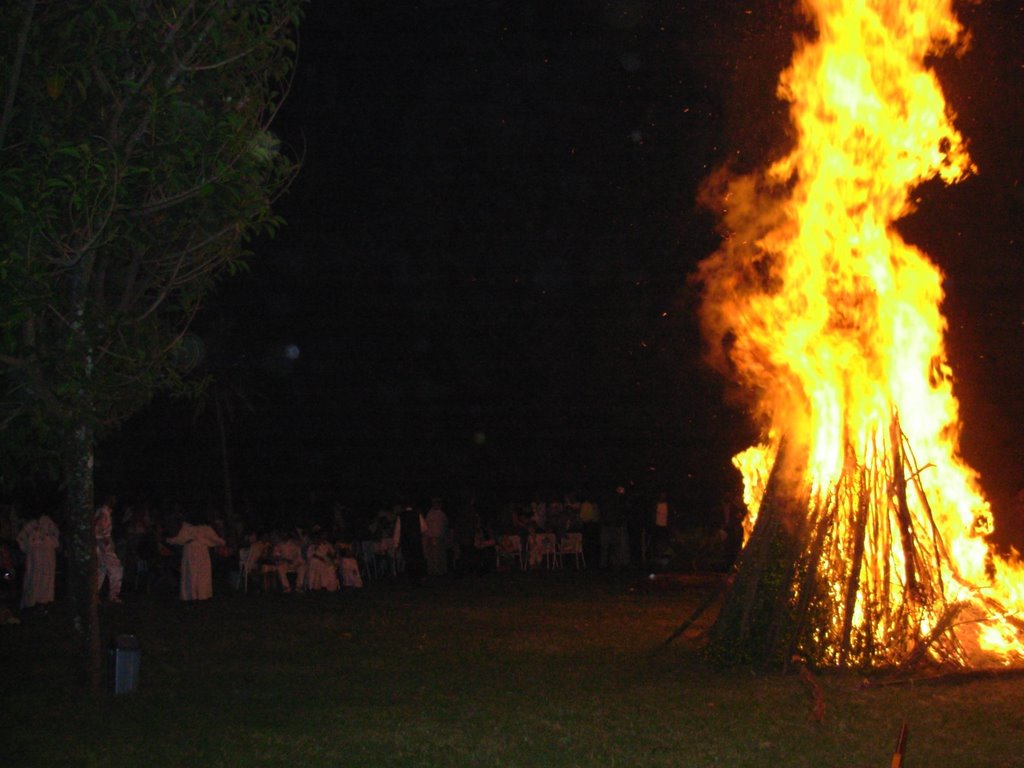
Meskal Celebrations ("The Finding of the True Cross")
Tuesday, September 05, 2006
Goodbye Canada; Hello Ethiopia!
Only five more days in Toronto before I'm on the plane! I can hardly believe it, after spending 4 years working towards this point.
I'm madly trying to check the last items off my to do list, accumulating student travel cards, firstaid kits, and traveller's cheques. I must admit that every once in a while there's also a frantic call to my mother!
I'll arrive in Addis Ababa on September 11th, which according to the Ethiopian calender is the start of the New Year. Already I've been invited to three parties by the friendly people in Addis that I've been in touch with! Ethiopia runs on the Julian calender, which has 13 months, unlike our 12 month one. So, when I arrive, we'll be celebrating the start of 1999. Hopefully there will be an interesting lead up to the Ethiopian Millennium while I'm there. I've already had a look at the site Ethiopian Millennium for an introduction.
This will be my last predeparture post from Toronto- next time I speak to you will be from Addis!
Kate
I'm madly trying to check the last items off my to do list, accumulating student travel cards, firstaid kits, and traveller's cheques. I must admit that every once in a while there's also a frantic call to my mother!
I'll arrive in Addis Ababa on September 11th, which according to the Ethiopian calender is the start of the New Year. Already I've been invited to three parties by the friendly people in Addis that I've been in touch with! Ethiopia runs on the Julian calender, which has 13 months, unlike our 12 month one. So, when I arrive, we'll be celebrating the start of 1999. Hopefully there will be an interesting lead up to the Ethiopian Millennium while I'm there. I've already had a look at the site Ethiopian Millennium for an introduction.
This will be my last predeparture post from Toronto- next time I speak to you will be from Addis!
Kate
Subscribe to:
Posts (Atom)
