Showing posts with label culture. Show all posts

Wednesday, October 24, 2007

World Press 2007

I'm never quite prepared for the intensity of the World Press Photo Exhibit. I'm always very excited to go, and then get stopped in my excitement tracks when I get there. I start having to breathe slower, prepare myself for what's around the corner. Zahra made the comment yesterday as we stepped from image to image, that what is hard to process is that there had to be someone there to take the photo. There had to be someone watching the man getting shot, the baby being burried, the gas main breaking, the boy waiting for interrogation by US troops in Iraq. It's hard to imagine being there.

Some of the ones that stuck with me include:

A ruined town in Kashmir, with rows and rows of men praying towards Mecca in the rubble of their mosque (Espen Rasmussen)


The juxtaposition of a group of African migrants arriving on the shores of the Canary Islands, and the bikini-clad toursits they enountered (Arturo Rodriguez)


Contestants in the Ms. Senior Sweetheart beauty pagent (Magnus Wennman)

Wednesday, May 30, 2007

Socially Conscious Web 2.0

Over the past months here in Ethiopia, I’ve managed to fall deeper into Web 2.0. For those of you not as enamored as I am, Web 2.0 is the latest generation of internet applications that feature user-driven content (like wikipedia, youtube, flickr, myspace…). My first foray into Web 2.0 is what you’re looking at right now: my blog. Since its inception, I’ve managed to join various online networking, photo and social book marking sites as well. And as someone who’s interested in getting Canadians and others involved in international development issues, I tend to look for the social consciousness in Web 2.0. I’ve been delighted to find several ways in which the internet is promoting the causes I feel passionate about.

For starters, I’m part of two online networking sites that are engaged in promoting community activism and global awareness: www.takingitglobal.com and www.idealist.org. These two sites allow you to link with others working for positive change, share your experience, and even find jobs within the field. TakingITGlobal focuses on getting youth around the world to increase their involvement through contributing to newsletters, developing artists’ pages, and joining organizations working on development issues online. I post my blog there as well, and have taken an online course on fundraising that they provided. Idealist.org has two neat components, the first mobilizing its members to increase dialogue on community and global issues through holding forums in their area, and the second allowing its members to build volunteer and speaker profiles to become more active in their causes. Both have allowed me to connect with other individuals who are interested in the same issues that I am.

As well, both the organizations I work for have online fundraising strategies that make use of Web 2.0 applications. For example, CAPAIDS annual Bike A Thon, which raises money to buy bikes for frontline Aids workers in Africa, is facilitated through an individualized donation system. Using a template, I can personalize my own donation page, including photos and my fundraising goals, and then send the link to friends and family. They can then donate online with their credit card, which means that instead of going door to door like I used to in high school, I can reach friends overseas or family back in Victoria.

Today I came across one of my most exciting discoveries so far, on the ubiquitous social networking site, Facebook. Usually reserved for connecting with friends you didn’t even know you knew and posting photos of last night’s debaucheries, Facebook has recently made an application available where you can feature a “cause” on your profile page and invite your friends to support the cause, and make donations if they choose. I looked at some of the most popular, and even though the Causes application has only been available for a few days, there have already been significant contributions. This from a demographic that purportedly thinks more about beer than poverty. CPAR hasn’t joined yet, as all the organizations available so far are based in the US, but I’m excited to feature the organization on my profile when they are listed, and encourage my friends to forget their student loan payments for a moment and support my Cause.

Hopefully this will encourage those of you who are holding out against Web 2.0 to dive right in!

If you do, here’s where to find me:

Site Username Description
www.takingitglobal.com jongbloed linking active youth
www.idealist.org katejongbloed linking active individuals
www.facebook.com Kate Jongbloed the social networking site
www.flickr.com katejongbloed my photos online
www.delicious.com katejongbloed online list of my favourite sites
www.goodreads.com Kate in Ethiopia like Facebook for books
www.ysn.com katejongbloed networking for young professionals

Tuesday, May 22, 2007

Islam in Ethiopia


After travelling to Lalibela’s rock hewn churches, visiting monasteries by mule and boat, and speaking frequently about Ethiopian Orthodox saints, I thought it was probably a good idea to check out Ethiopia’s other major religion: Islam. I work with Ahmed, a practicing Muslim, and a former employee at the Ethiopian Islamic Council, so I figured he’d be my in. I’ve spent the past nine months trying to remember not to shake his hand! We arranged an appointment on Friday afternoon, before prayers, so that I could visit the Grand Mosque in the heart of Addis’s biggest market (less than a block away from an equally large Orthodox church). Before I left to meet him, I practiced putting on my hijab with the help of another coworker, Saade. As I walked around my office with it on, my coworkers began to call me Amina!

I was early for our appointment, and for the first time in Addis, I felt thoroughly out of place as I waited in front of the men’s gate at the Mosque. Even the little Amharic I’ve gained didn’t apply: the beggars I encountered all wore prayer caps, and the only way I know to fend them off is by saying, “God will provide.” Except that in this case, I would have been talking about the wrong God. I kept on waiting for someone to say, “You don’t belong here,” but of course they didn’t.

When Ahmed arrived, we met the administrator of the Mosque, and he showed us around the women’s part, which made Ahmed very uncomfortable. As we walked around, he commented on my long skirt, saying that I looked like a true Muslim. I didn’t have the heart to tell him that the top part of my dress, hidden by a sweater, would have made him change his mind!

At ten minutes before seven we prepared for prayer. I left Ahmed half way, as he went to the men’s part and I headed back towards the woman’s part. As I walked up the stairs, wondering how this was all going to work, two young women in full chador beckoned me over. Placing me between them in our straight prayer line, three rows back from the front, they signaled to me that I should follow their example when the prayer started. And so, we bent forward, kneeled, put our heads to the floor, stood up, crossed our arms, and held out our index fingers in symbol of Allah. When we were finished, the girls asked me my name. When I replied, “Kate,” they said, “No, your Islamic name.” Amina.

I stayed Amina, under my headscarf, all the way home.

Monday, May 07, 2007

Tekla Haymanot


I’ve talked before in this blog about Ethiopian Orthodox Christianity, and I become steadily more interested in it as I realize its pervasiveness in society here. As usual, religion is a crucial part of the history and the present of this country.

There are several saints revered in Orthodox Christianity here, some indigenous, and others that are specifically Ethiopian. I’ve mentioned before how each church is named after one, and each of the days of the month is attributed to a specific saint. One can ask a Christian Ethiopian, “Who is your saint?” and they will answer immediately. When significant events happen here, like the birth of a child or some sort of near-death experience, people pick the saint of that particular day as their saint, and will pay special attention to religious duties on that saint’s day. Often, they’ll light candles, or attend service on that day each month, and will go to the church with that saint’s namesake.

My Ethiopian saint is Tekla Haymanot. A couple of months ago, I was in a car accident with two friends on the way home from Debre Sina where an intern friend was sick with typhoid fever. At a bend in the road, the driver lost control of the car because of problems with the steering and a pothole. We flew down the hill beside the road, narrowly missing trees and rocks, and as we swerved to avoid a farmer’s field and barbed wire fence, the momentum threw me through the closed window. I landed, a bit dazed, on the ground as the car continued for a few meters before stopping. The two friends left in the car looked into the back seat to see if I was okay, and were terrified when they didn’t see me sitting there. As they got out of the car, I stood up, unharmed except for what would become a huge bruise on my thigh and a couple of scratched elbows. No one else was hurt. On our way off the road, we could have hit a tree, crumpling the front of the car, or hit a rock and flipped over, either of which would have caused serious damage to us in the car. But we didn’t.

When we drove back into Addis, I visited with the Ethiopian family living behind our house, and asked them what saint’s day it was that day. We lit a candle for Tekla Haymanot, and he’s been my saint ever since.

The story of Tekla Haymanot says that he showed a special ability in performing miracles during childhood, and went on, later in life, to pray without interval for twenty years. He spent the whole prayer standing, and at one point, his right leg rotted and fell off. He continued for seven more years standing only on his left. You can find the rotten leg in a church in Debre Libanos. It comes out once a year, and those that revere him are permitted to drink the water in which the leg is washed.

Currently reading: The Chains of Heaven by Philip Marsden, the true story of his journey hundreds of kilometers on foot between Lalibela and Axsum, two of Ethiopia’s most holy places. The story of Tekla Haymanot above was taken from the book, and from accounts of Ethiopian friends. The painting of Tekla Haymanot was done by my fabulous artist friend, Geta Mekonnen.

Monday, January 22, 2007

Timket Celebrations in Addis Ababa

One of the biggest celebrations of the Ethiopian Orthodox Church is Timket, or Epiphany. This weekend, the streets were full of Ethiopian Christians following the march of Ark of the Covenant replicas around Addis Ababa.

Timket crowds following the Ark of the Covenant

Three women in Ethiopian traditional clothes

A little Ethiopian dressed in traditional clothes

Ethiopian Orthodox Clergy and the Ark of the Covenant

Timket Ceremony at Medhane Alem Church

Wednesday, November 22, 2006

Reflection after 2 Months

I have just past my 2 month mark here in Ethiopia. Before leaving, I had been preparing for my year abroad since getting into the International Development program at the University of Toronto, and felt ready for anything. More specifically, I felt ready for an extremely difficult year of cultural difference, heart wrenching poverty, and loneliness. I couldn’t have been more wrong. There is something about Ethiopia and Ethiopians that make my time here so different from the year I was expecting.

To start off with, I am moved daily by the universal generosity here. Sometimes the culture of beggars here frustrates and disturbs me because it is so entrenched in society. How can growth and development occur if people ask for money and food rather than doing something productive to earn a living? But the thing that amazes me about it is that every single Ethiopian, no matter how poor they are themselves, will find 10 birr cents to put into the hands of a blind man or leper that comes to ask at the door of the minibus, or a quarter to give to the rural woman in rags with a baby strapped to her back. This distribution is common among everyone. Even when you present someone with a gift, they thank you and take it (without the protestations we are used to in the West), because they know that they or someone else will return the generosity to you in the near future.

This redistribution relates closely to perspectives of poverty among the poor themselves. Ethiopia is the 5th poorest country in the world, it suffers frequently from natural disasters and food insecurity, and the rate of HIV/AIDS is steadily increasing. I knew not to expect the glamorized distended bellies that appear on World Vision commercials, but still those images were there in my head. I met an 18 year old woman last week. Her mother had died from AIDS contracted from commercial sex work, she and her brother had been raped by men in the community, and she has a 4 year old daughter as a result. Now, as the oldest child in the family, she is responsible to take care of her daughter, brother and sister. Despite these terrible difficulties, the woman was smiling and welcoming as I entered her house. Her attitude showed that despite poverty, life and happiness continue, and she’ll do what it takes to provide herself and her family with a better future. Apart from the odd pessimist, this mentality has been visible in all the struggling people I’ve met, from CPAR beneficiaries to my neighbours and friends.

At CPAR, I’ve been surprised by how wrong my expectations were as well. During pre-departure training with the University and CIDA, we often talked about cross-cultural difficulties in the work place. I was to expect that as an independent Western woman, I would find things in office that contradicted my understanding of myself and my worth, or even simply made deadlines hard to meet. I wouldn’t necessarily be able to be “me”. Over my first few weeks here, I tried to keep my “heart-on-my-sleeve” temperament in check, keeping culturally sensitive issues to myself, like my lack of religion, my acceptance of homosexuality, and my tendency to take control to get things done. As I became closer to friends at work, I realized that they understood and expected me to be different, and that was okay. The first time my “get it done mode” kicked in before a deadline, I called my boss later to apologize for my assertive behaviour, but was encouraged to take this roll again when needed. And one of the favourite past times of my co-workers and me is to joke about our respective cultures. If you come by the office at tea time one afternoon, you’ll see me walking around like a chicken, poking fun of the “Toronto hurry”.

The generosity, positive attitude, hope and tolerance of Ethiopians contributes daily to my African happiness. At this point, I feel more at home here than I have in Toronto, with fulfilling work and a great social life. I might have felt prepared to leave Canada and come to Addis, but I can’t imagine what it will be like to go back. Only 8 months to go.

Sunday, November 12, 2006

Believe it or Not

Most Ethiopians Believe. In fact, I haven’t met one yet who doesn’t.

According to my pre-departure Ethio-Info package, the population is made up of about 45 percent Orthodox Christians, 35 percent Muslims, and 20 percent “Other”. These three groups live together in relative peace, although people tell me that tensions are rising because of the global climate.

As an agnostic with no history of religious affiliation, I wondered what such a pious population would think of me, and whether it would affect my work environment. When asked about my religion, I get different reactions from different people. Some want to take me immediately to get baptized. Others don’t quite understand it, “does that mean that you are a pagen?” as they can’t imagine not having at least some sort of god in life. And others take my lack of spirituality in stride, saying that they’ve met other Canadians who have the same attitude, and they think it’s normal for us.

Since I’ve been here, we’ve celebrated the Christian holiday of Meskel, lived through the month of Ramadan and experienced the Islamic holiday Eid. But it’s not just these big holidays that get the faithful riled up here. Each church has a patron saint and a certain day of the month when that saint is worshipped, bringing in crowds of people, praying, selling and begging. Driving by, you can tell what saint’s day it is by the number of people around the church. It’s possible to follow the celebrations around the city from church to church, if you like the crowds of people and loudly broadcast messages from the Bible. The poorest people in Addis follow them too, knowing that Ethiopians are more generous on holidays.

Yesterday was the annual worship and celebration for Medhane Alem (“Medicine of the World,” or Jesus) which is the church across from my house. When I stepped out of my compound onto the street yesterday, I wasn’t expecting to end up in a sea of begging bodies, bright umbrellas and ladies in white head scarves, a sermon blasting from the huge speakers. A coworker took me inside the church compound after work. I’d been nervous to go, as tourism in other people’s holy places makes me wonder, but she encouraged me to come and see the festivities. The scene was a strange mix of serious and celebratory. I was surprised at how individual the worship and prayer were, not with a priest in a pulpit, but one broadcasting over the loudspeaker from the front steps. Inside the church itself, worshippers got down on their knees or raised their hands in the air without direction from a member of the church hierarchy, and the sheer emotion of faith that many exhibited was quite moving. As I moved outside again, I realized that of the thousands of people in the compound, there was a careful division between men and women. The aesthetic result was powerful: white clothed women on one side, and men in dark suits on the other.

As I walked through, with my own white head scarf falling back from my forehead, I made mental notes of the practices, trying to fit the whole situation into my world view. The Saints, and the sign of the crucifix made me think of Catholicism. The people with their heads pressed up against the wall of the church in prayer made me think of Judaism. And the division of men and women, and the head scarves, reminded me of Islam. How did I end up in such a unique country?

Wednesday, October 11, 2006

Embarassing Moments

There is something about being in a foreign country with different systems and ways of doing things, combined with the fact that I am so visible as a foreigner, that leads to frequent embarrassing moments.

The first in the series was a couple of weeks ago now (and I’m only just ready to talk about it!). I was walking along the dirt road towards the CPAR compound. In order to make it to the gate, I had to make a right turn, but coming up on my right side was a horse and cart. Not too familiar with horses, I thought that I could make it in front of the buggy. As I went for it, I realized what a miss calculation that was, and in my hurry I dropped my cell phone. I reached back for the phone, to get it safely out of the way of pounding hoofs, and as I did, a roar of shock and laughter went up from the row of merchants across the street. I made it safely into the compound, unscathed. When I decided to venture outside again about an hour later, the laughter began once again at the mere sight of the farenj who almost got hit by the horse!

My cell phone works on a pay-as-you-go system. Each time I run out, I fill it up using the code on the back of a card. The prompts on the card are in English, but over the phone they’re in Amharic. The other day, my phone ran out of minutes for the first time: I dialed the number of one of my Canadian friends, and in response got a stream of Amharic. I figured that maybe the maid had picked up the phone, so I tried in my broken Amharic to explain that I wanted to talk to Dwayne. But she just kept on talking, repeating the same thing over and over again in a language I couldn’t understand. She didn’t even try to say anything about Dwayne! ‘Rude,’ I thought, and hung up the phone. Slowly it dawned on me that I had probably just tried having a conversation with a recording, telling me that my phone credit had run out!

While we were in the CPAR Jarso project areas, visiting with the beneficiaries, one of the farmers reached into his field and picked some pea pods and offered them to me. They contained the sweetest and tastiest peas I’d ever tasted. Two weeks later, I found a man with a wheelbarrow on the corner near my house, selling the same pods. I spent 3 birr (about 40cents Canadian) on half a kilo and took them home for dinner. Unfortunately when I opened the first one, they were mealy and tart. I tried the next one, and experienced the same thing. Not wanting them to go to waste, I brought them to the Lunch Club leader, to include in the menu (cooked) sometime this week. I guess he misunderstood my intention, because the Tea Lady has just arrived in my office with a heaping plate of boiled peas, still in the pod! Coworkers keep coming into my office, looking at the plate of food with a strange glance, and pretending it doesn’t exist. I think I’ll donate it to the lunch buffet when 12:30 hits.

Monday, October 02, 2006

Meskel and Jarso

Things are getting very busy here for me! My to do list for this week is a mile long, but it consists of diverse and interesting tasks, so I'm very happy with it!

This past week was a unique one: first a holiday on Tuesday and Wednesday, and then a trip to the field with CPAR to Jarso Woreda (Jarso district).

Jarso was great, as I got to meet the CPAR staff that actually makes the projects happen, as well as the beneficiaries of the projects. I went on a hair-raising drive through one of the project areas (a rocky road at the edge of a very high cliff- beautiful, but slightly intense), and then visited with many of the farmers and families that participate in CPAR's activities. I was familar with all the interventions from volunteering with CPAR before, but the thing that was so great to see is just how involved the community is in each of the actions. For example, one of the farmers has recieved a bull from CPAR to grow his cattle herd. But he also offers the same service to other farmers in the community. Another example is a woman participating in the savings and credit organization- she has put CPAR's HIV/AIDS education posters in her house for guests and customers. There were many more examples of how CPAR's beneficiaries turned around and gave back to their community in some way.

On the way back to Addis, there were many events on the road that reminded me once again that I'm not in Canada anymore! There was a race down the side of the highway. Running is huge in Ethiopia, and it's a very big deal. You watch these lanky men, in bright red running shorts, sprinting along. And then you realize that some of them aren't wearing any shoes! At another point we noticed a line of people with guns on their shoulders at the side of the road. And all of a sudden, a line of horses spanning the highway, decked in costumes and ridden by men singing at the top of their lungs are charging towards us!

And then you're just driving through regular Ethiopian highlands once again.


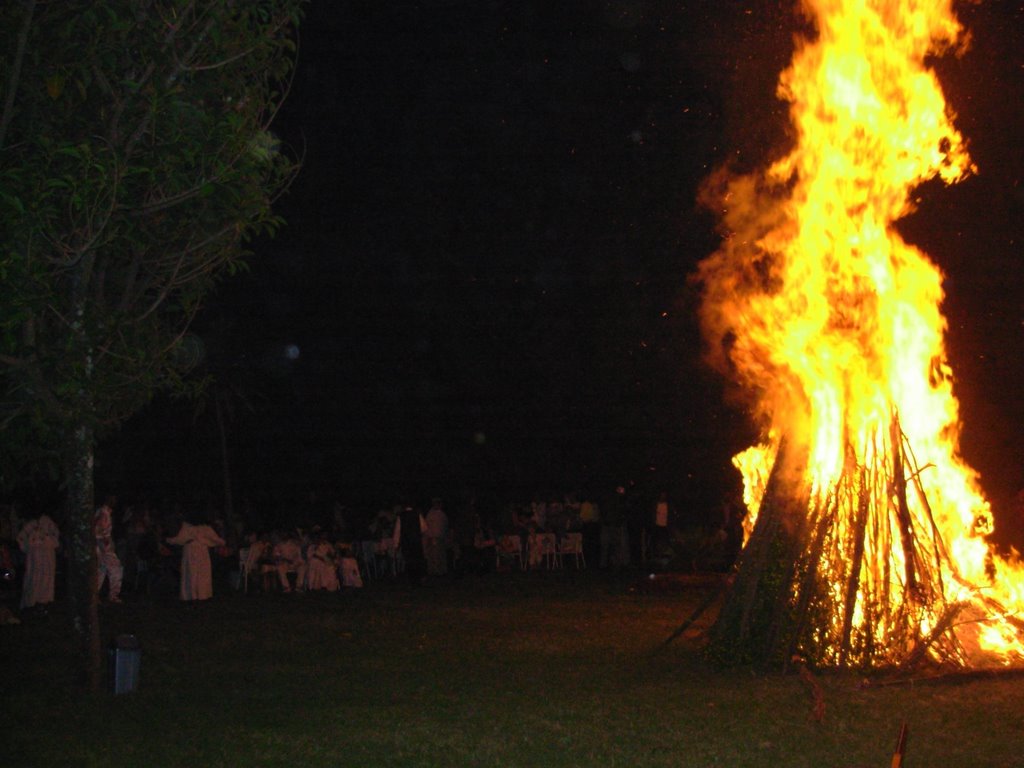
Meskal Celebrations ("The Finding of the True Cross")